Better Off Treatment
Body Microneedling & Stretch Mark Treatment
Microneedling for body skin texture, stretch marks, and scars across treatable areas.
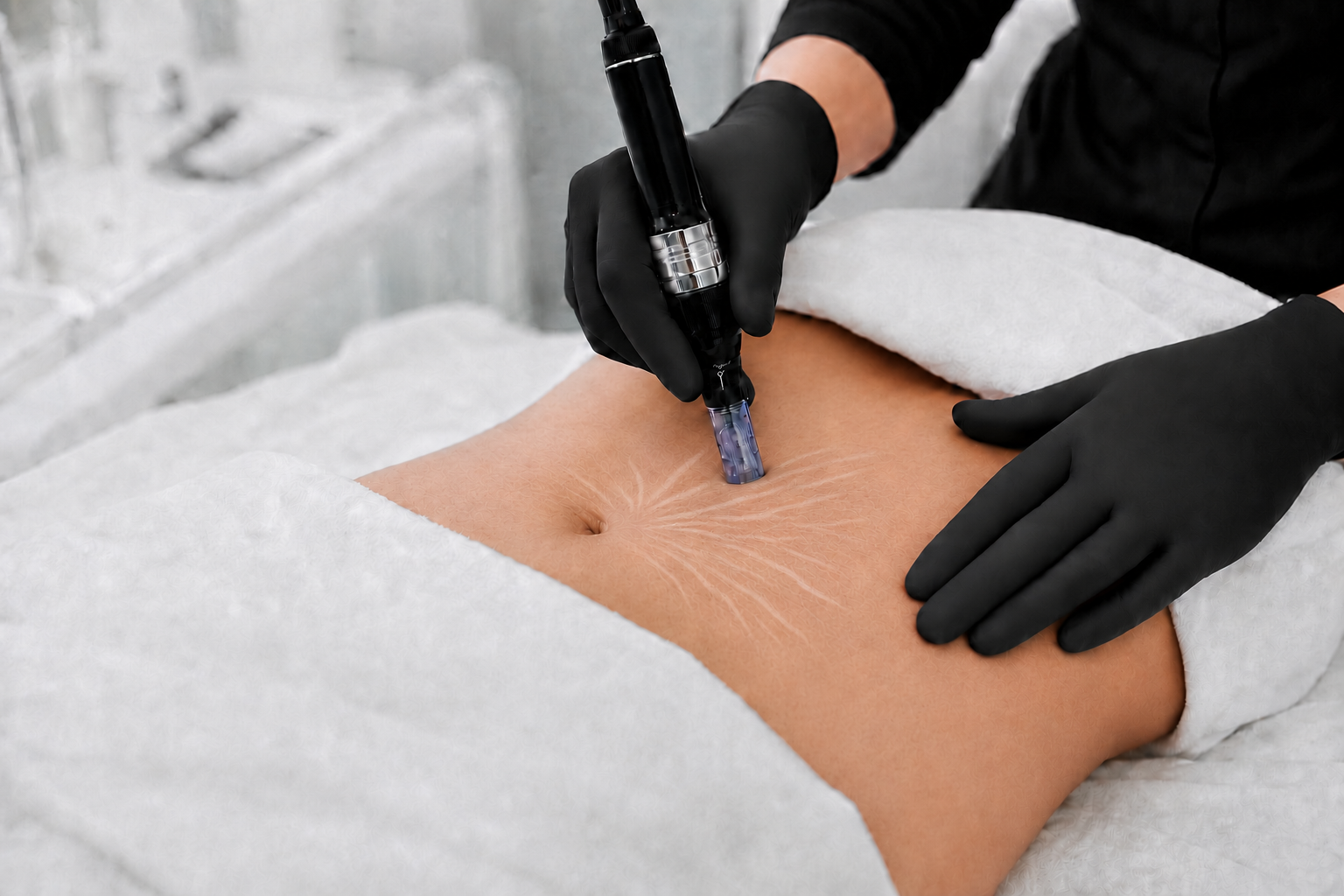
Body microneedling is a controlled collagen-remodeling treatment for the skin on your body — stretch marks, healed scars, crepey or thinning skin, and areas of rough or uneven texture. It uses the same core mechanism as facial microneedling: precisely controlled micro-injury that triggers your skin's own repair response and builds new collagen over time.
But body skin is not facial skin on a larger canvas. It varies dramatically by location — thicker in some areas, thinner in others, under different tension, and slower to turn over — so the depth, density, technique, and treatment plan are built specifically for the body area being treated. If your concern is on your face, see Microneedling.
Related concern
Understanding Stretch Marks
Newer red or purple stretch marks and older white, textural stretch marks are different stages of the same atrophic scar — and they respond to different treatment strategies focused on remodeling, not just color.
Explore the Stretch Marks guideRelated concern
Understanding Body Composition & Muscle Loss
Weight, fat, muscle, and skin all shape how the body looks and functions. When muscle volume drops, contour can flatten and strength can decline — even if the scale looks better.
Explore the Body Composition & Muscle Loss guideHow it works
Fine needles create thousands of microscopic channels at a controlled depth. Your body reads those micro-injuries as a signal to repair: the wound-healing cascade produces new collagen and elastin over the following weeks and months, gradually remodeling the treated skin from within. The channels can also enhance the delivery of topical products applied immediately afterward.
Why the body needs its own approach: body skin differs from facial skin in almost every way that matters for treatment. The dermis varies in thickness by location, oil glands are sparser, cell turnover is slower, and areas like the abdomen sit under constant tension while lower legs heal more slowly. That means needle depth, pass density, session spacing, and the number of sessions are all adjusted for each area — not carried over from a facial protocol.
What body microneedling addresses
Body microneedling is used where collagen remodeling can improve the look and quality of skin, including:
- Stretch marks — post-pregnancy, growth-related, or from weight change.
- Surgical scars — C-section, tummy tuck, breast surgery, and other incision scars once fully healed.
- Traumatic scars — from injuries, burns, or prior procedures.
- Selected atrophic or depressed scars — where texture can be improved through remodeling.
- Crepey or thinning skin — where collagen support can restore a firmer appearance.
- Texture irregularity — rough or uneven skin quality across a body area.
- Selected areas where collagen remodeling may be useful — determined at your evaluation.
Every concern is evaluated first. Some respond best to microneedling alone, some to combination treatment, and some to a different approach entirely — that is exactly what the evaluation determines.
What stretch marks actually are
Stretch marks (striae) are tears in the dermis — the deeper layer of skin — that occur when skin stretches faster than its collagen network can accommodate: rapid growth, pregnancy, weight change, muscle gain, or certain medications. When they first form, stretch marks are typically red or purple (striae rubra): active, vascular, and still changing. Over time they fade to white or silver (striae alba): mature, scar-like tissue.
Because stretch marks are structural changes in the dermis, surface-level creams rarely move them meaningfully. Treatments that actually remodel dermal collagen — like microneedling — address the problem at the layer where it exists.
Why older and newer stretch marks respond differently
Newer stretch marks — the red or purple ones — are biologically active and still have blood supply, so they generally respond faster and more noticeably to treatment. Older white or silver marks are mature scar tissue: they can still improve in texture, firmness, and how well they blend with surrounding skin, but they typically need more sessions and come with more conservative expectations.
The age, color, depth, and location of your stretch marks all shape the plan — which is why your evaluation starts with a close look at the marks themselves, not a preset protocol.
How scar type and depth shape treatment planning
Not all scars are the same, and the differences matter:
- Flat, linear surgical scars — often respond well to texture remodeling once fully healed.
- Depressed or atrophic scars — may benefit from collagen-building treatment, and in selected cases from injection-based correction as well.
- Raised or hypertrophic scars — a different problem that can require a different approach; microneedling is not automatically the answer.
- Tethered scars — pulled down by fibrous bands that may need release (subcision) before surface remodeling can help.
- Pigment changes around a scar — a separate issue from texture, treated separately.
This is why Better Off evaluates the scar itself — type, depth, age, and behavior — before recommending anything. The right tool depends on what the scar is actually made of.
Where we treat
Body microneedling can be applied to most body areas, with settings adjusted for each:
- Abdomen — including post-pregnancy stretch marks and healed C-section scars.
- Thighs and hips — common areas for stretch marks and texture.
- Buttocks — stretch marks and skin quality.
- Upper arms — texture irregularity and crepiness.
- Knees — where skin folds and thins with age.
- Chest and décolleté — delicate skin treated with appropriate depth.
- Hands — thinning skin and visible structure; part of our broader approach to hand rejuvenation.
- Other appropriate body areas — discussed at your evaluation.
What to expect — realistic results
- Improvement is gradual. New collagen forms over weeks to months, so results build progressively rather than appearing overnight.
- A series is usually more appropriate than a single treatment. Most stretch mark and scar plans involve multiple sessions spaced weeks apart.
- Substantial improvement, not erasure. Stretch marks and scars can improve markedly — in texture, firmness, and how well they blend — but they rarely disappear completely, and anyone who promises otherwise is not being honest with you.
- Results are individual. The age of the mark or scar, its depth and location, your skin quality, and your own healing biology all influence what is achievable.
- Maintenance can help. Some patients benefit from periodic additional sessions as their goals evolve.
Typical course
A typical path starts with a body skin and scar evaluation: we map the areas, assess the age and type of each mark or scar, and set honest expectations for what treatment can achieve. From there, a series of sessions is spaced weeks apart, with settings tuned to each area's skin thickness and healing behavior. Remodeling continues between sessions — many patients see improvement building for months after the series ends — and we reassess results before deciding whether further treatment makes sense.
Maintenance
After your series, protecting the results matters: sun protection over treated areas, consistent skin hydration and barrier care, and — for ongoing concerns like crepiness — occasional maintenance sessions. Your plan will include what to use, when to return, and what to watch for as your skin continues to remodel.
Combination treatments
Some body skin concerns respond best to more than one approach — and no patient needs every option. Selection is driven entirely by your evaluation:
- PRP/PRF Skin Therapy — regenerative support that can be applied alongside microneedling to amplify the remodeling response.
- PDRN — a selected skin-repair-support option considered in appropriate plans.
- Medical Grade Peels — where discoloration or surface-level pigment is part of the concern.
- Laser-based treatment — resurfacing or rejuvenation options where appropriate for the mark, scar, or skin quality in question.
- Subcision or injection-based correction — for selected tethered or depressed scars where releasing or supporting the tissue changes the outcome.
Natural next steps to explore:
- Microneedling — the facial treatment and the mechanism behind this one, in depth.
- Acne Scar Restoration — where acne-related texture or scarring is part of your picture.
Common questions
Ready when you are
To schedule your Body Microneedling & Stretch Mark Treatment, book online anytime — or text or call us and we'll get you on the calendar.For the fastest response, text us.
Real Medicine. Real Results.