Better Off Solutions
Acne Scars
Acne scars are not all the same. Their shape, depth, tethering and underlying tissue changes determine which treatments are most likely to help.
Prefer to ask first?Text us|Call 760-452-2722
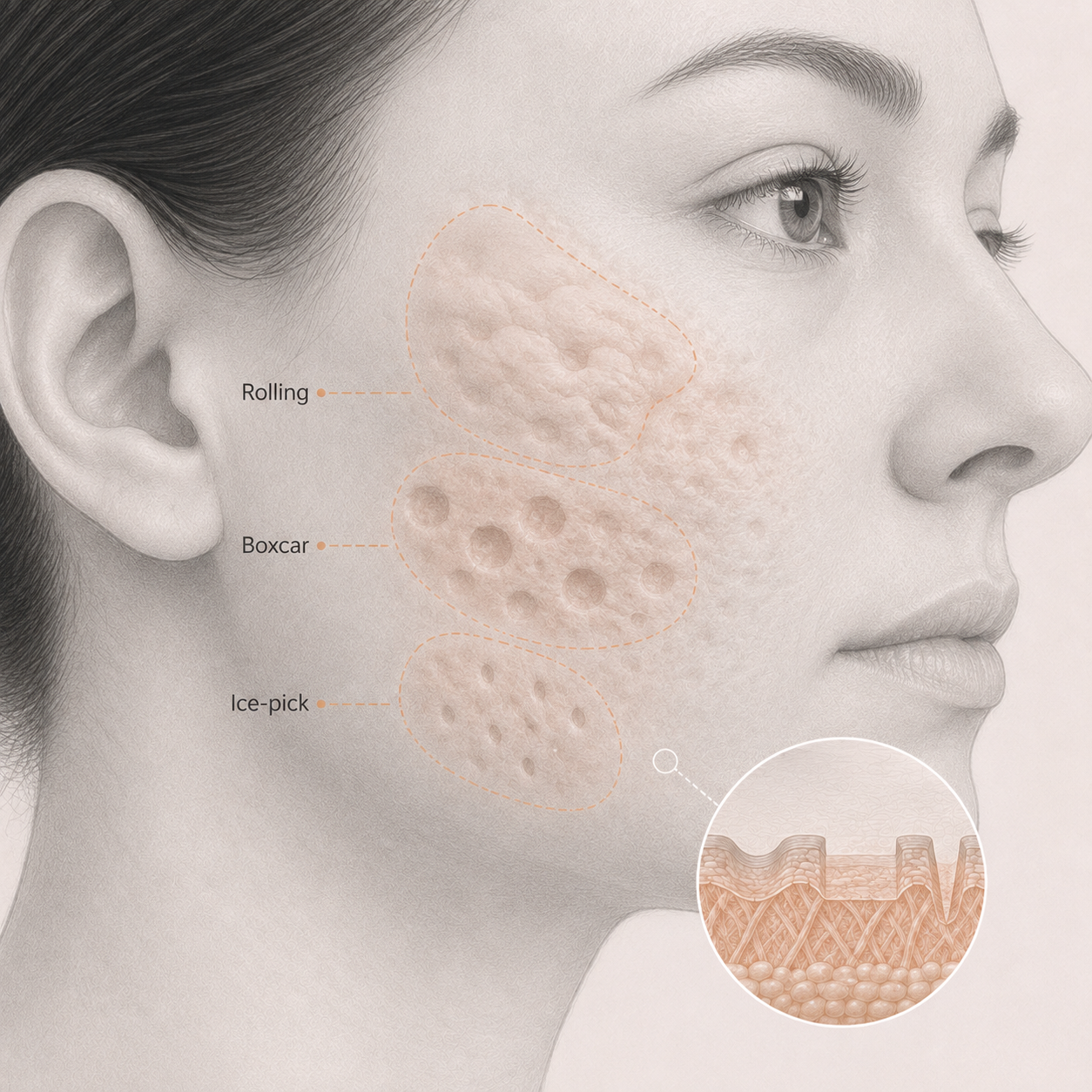
Not all acne scars are the same
Two scars can look similar on the surface and behave completely differently. One may sit shallow and roll gently with your expressions; another may drop sharply with defined edges; a third may be pulled downward by fibrous bands under the skin.
That distinction matters because the shape, depth and tethering of a scar determine which treatments are most likely to help — and why a plan that worked for someone else may not be the right plan for you.
Better Off approaches acne scarring the way we approach everything: understand the problem first, then select treatments intelligently — not the other way around.
What kind of acne scars do you have?
Most acne scarring is atrophic — depressed scars formed when inflammatory acne damages the dermis and the skin heals with less collagen than it lost. Within that family, the main patterns behave differently:
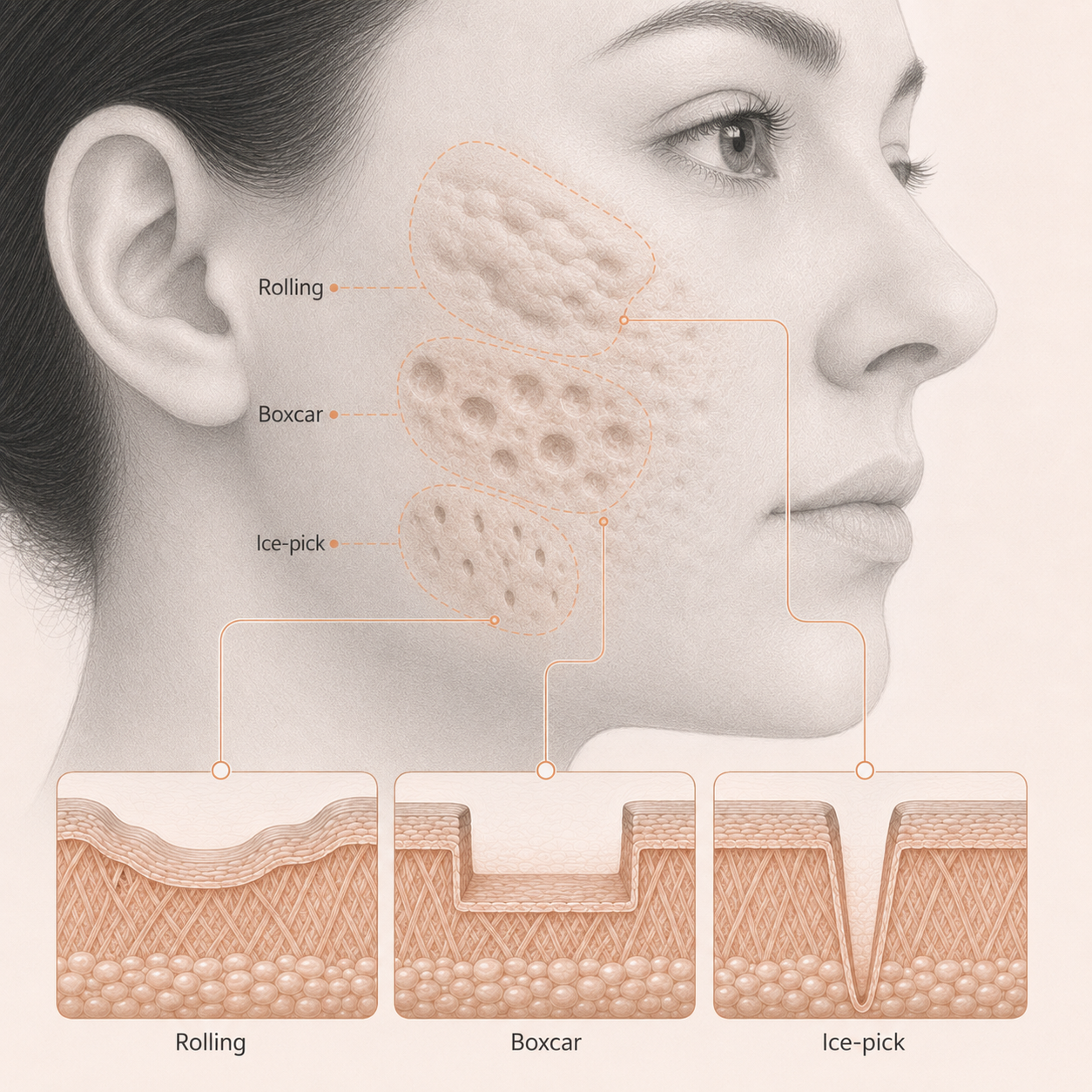
Rolling scars
Broad, shallow depressions with sloping edges that can make the skin look wavy or uneven, especially in certain lighting. Some rolling scars are tethered underneath, which changes how they respond to treatment.
Boxcar scars
Round or oval depressions with more defined, sharply demarcated edges. They can be shallow or deep — and depth matters, because deeper boxcar scars usually need a different approach than shallow ones.
Ice-pick scars
Narrow openings that extend relatively deeply into the skin. Despite their small size, their depth can make them harder to reach with surface-level treatments alone.
Post-inflammatory discoloration (not always a true scar)
Brown, red or purple marks left after acne are not necessarily true scars — they are pigment or vascular changes, and they often require a different treatment strategy than textural scarring. Not every post-acne mark is a scar, and that distinction shapes the plan.
The Better Off Insight
Why one acne-scar treatment rarely fixes everything
Acne scars are layered problems, and different treatments address different layers:
- Resurfacing and remodeling may improve texture and stimulate collagen
- Deeper or sharply edged scars often behave differently from shallow ones
- Tethered scars may require a different approach than untethered scars
- Pigmentation or redness is a separate issue from structural scar depth
That is why combination or sequential treatment is sometimes more appropriate than repeating one modality — not because more procedures are automatically better, but because different problems need different tools.
Our sequencing logic starts with a simple question: what is the primary problem? Tethering, depth, surface texture, collagen loss, pigment — or a combination? We select treatment accordingly, then reassess the response before adding anything else.
Scar depth is only part of the story
What you see on the surface does not always reveal what is happening underneath. Two depressions of similar depth can have completely different structures — and therefore different treatments.
When we evaluate a scar, we are looking at several factors at once:
- Scar depth — how far below the surface the depression extends
- Scar-edge shape — sloping and soft (rolling) versus sharply defined (boxcar)
- Collagen loss and dermal remodeling — how much support the skin lost and how it healed
- Tethering / fibrous attachments — whether the scar is anchored downward from below
- Volume loss or contour change — where depression is partly a support issue
- Active inflammation versus established scarring — whether acne is still active in the area
- Pigment or redness versus structural scarring — color changes and texture changes are different problems
This is why a visual glance is never enough. The same-looking scar can need a different plan depending on what is driving it underneath.
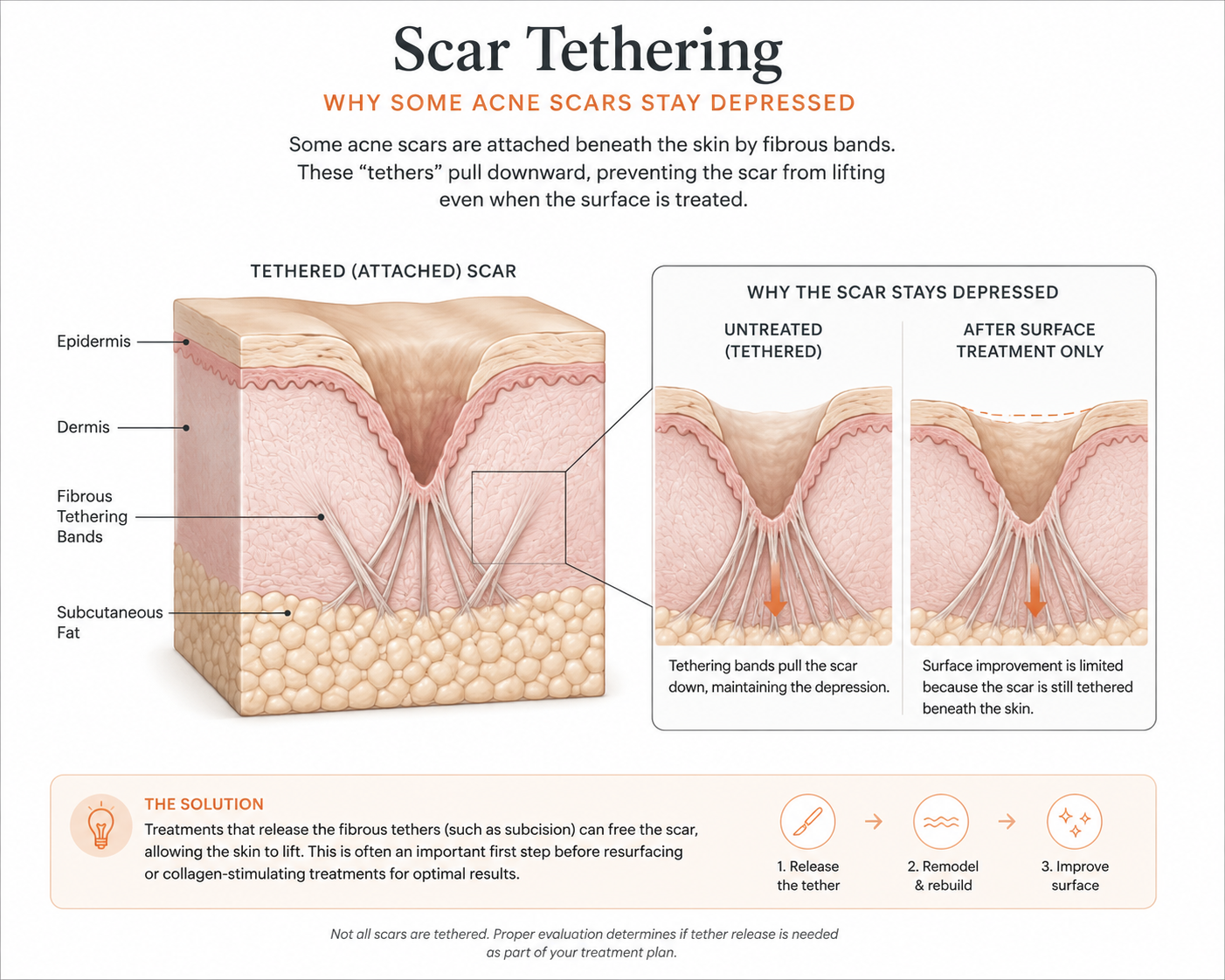
Tethered acne scars: anchored from below
Some depressed scars are held downward by fibrous attachments — bands of tissue that anchor the scar to deeper structures beneath the skin.
When tethering is present, simply resurfacing the top layer may not fully correct the depression, because the scar remains anchored below. The surface can be smoothed while the depression persists.
Identifying tethering changes the treatment plan. It is one of the reasons we evaluate scars carefully rather than defaulting to a single procedure — whether a scar is tethered can determine whether a release-based approach belongs in the sequence.
Treatment paths
How we approach it
Microneedling
Controlled micro-injury that stimulates collagen remodeling — most useful for surface texture, shallow rolling scars, and overall skin quality improvement over a series.
PRP / PRF Skin Therapy
Platelet-based regenerative support that can be layered onto microneedling to amplify the remodeling response — considered when healing quality and collagen stimulation are the goal.
Medical Grade Peels
Chemical exfoliation that addresses surface texture and pigment — most appropriate when discoloration and shallow irregularity are part of the picture.
Laser Skin Rejuvenation
Light-based remodeling where appropriate for texture and tone. Suitability depends on scar pattern, skin type and history — laser is not automatically the answer for every scar.
Injection-based correction for selected depressed scars
For certain focal, depressed scars, filler-type support can soften a depression that remodeling alone would not fully correct. This applies to selected scars only — never a blanket approach.
Mesotherapy Microinjections
Targeted microinjections that place skin-supporting ingredients into the treatment area — used as a skin-quality and collagen-support strategy alongside other approaches where appropriate.
The Better Off Way
The Better Off approach: identify the scar before choosing the treatment
We do not sell scar packages. Every plan starts with an individualized evaluation that distinguishes your scar types, because a one-size-fits-all approach cannot work when scars themselves are not one-size-fits-all.
From there we build a strategy — the right tools, in the right order — and we set realistic expectations from the start. Treatments are chosen for your actual scar pattern, and the plan is adjusted as your skin responds.
Identify
Evaluate scar type, depth, tethering, pigment and skin quality before any treatment decision.
Sequence
Select the treatments that match the scar pattern — in the order that makes clinical sense.
Reassess
Review how the skin responds before adding anything, and adjust the plan accordingly.
Realistic expectations
Acne scars can often be improved substantially — but established scars generally cannot be promised to disappear completely, and anyone who promises perfect skin is not setting you up well.
How much a scar improves depends on:
- Scar type and depth
- The age of the scars
- Your skin characteristics and healing response
- The treatment modality used
- The number and sequence of treatments
Improvement usually happens gradually over a series, not in a single visit — and maintenance and good skin care still matter after the scar work is done.
Your plan, your combination
Tools We May Use in Your Plan
These are the treatments we may draw on depending on what your evaluation shows. Not every option fits every patient — the plan is built from what actually applies to your scars.
Acne Scar Restoration
Resurfacing treatments that soften scarring, even out texture, and bring back a healthy-looking glow.
Medical Grade Peels
Medical-grade chemical peels for textural issues, fine lines, pigmentation, and melasma.
Mesotherapy Microinjections
Targeted skin-boosting microinjections for hydration, texture, tone and overall skin quality.
Microneedling
Stimulate collagen, smooth texture, and refresh your skin — for fine lines, acne scars, pores, and skin texture.
PRP/PRF Skin Therapy
Regenerative skin therapy using your own growth factors to improve tone, texture, and overall skin quality.
Laser Skin Rejuvenation
Laser resurfacing and rejuvenation for tone, texture, sun damage, and overall skin quality.
Real Medicine. Real Results.
The first step is an honest evaluation
We'll identify what's actually driving your concern, then build a plan around it — the right treatments, in the right order, with follow-through.
Frequently asked questions

Real Medicine. Real Results.