Better Off Solutions
Hair Loss & Thinning
Hair can become thinner for very different reasons. The pattern of loss, rate of shedding, follicle health, hormones, nutrition and other medical factors help determine what treatment makes sense.
Prefer to ask first?Text us|Call 760-452-2722
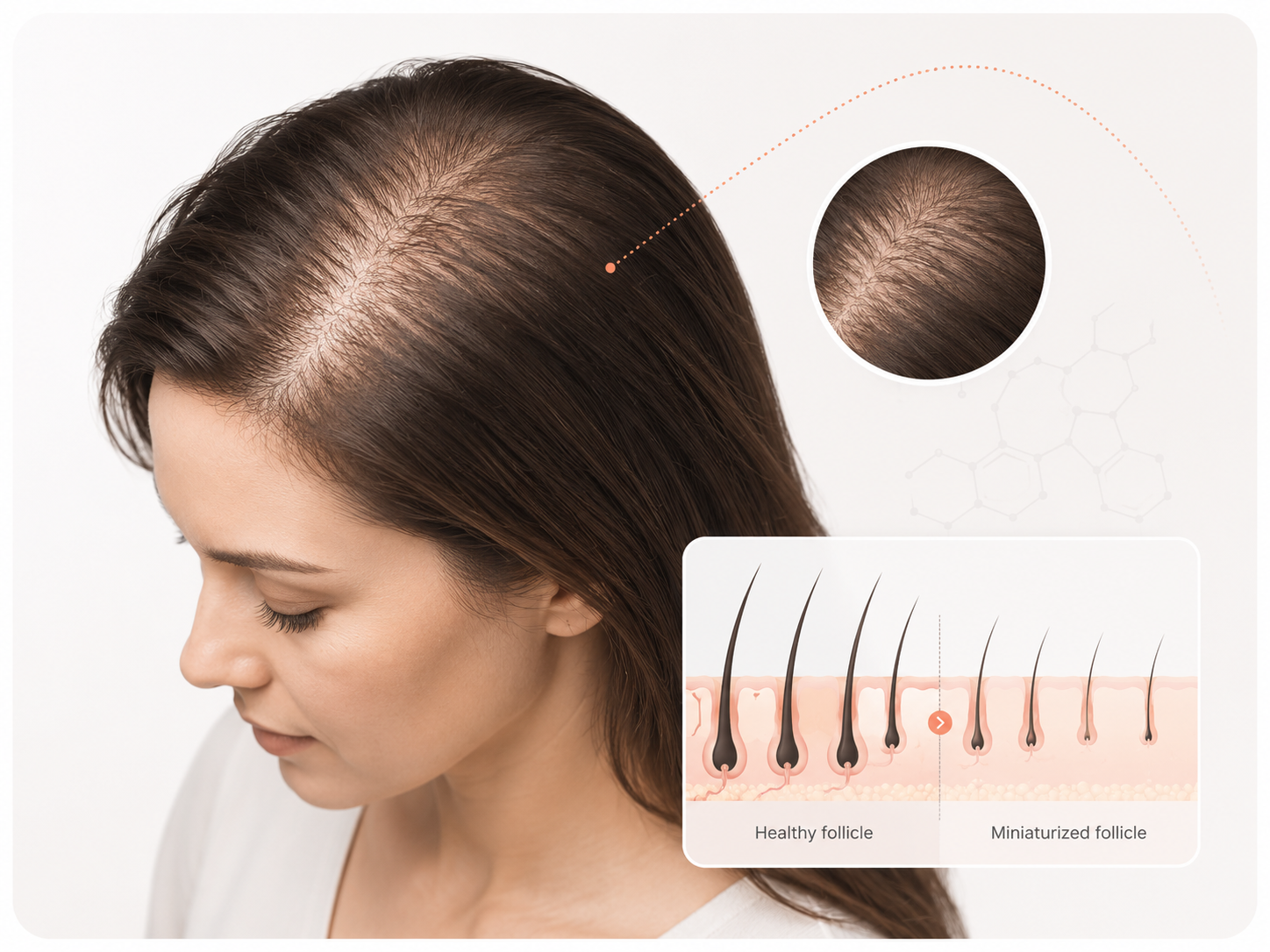
Why is your hair getting thinner?
Visible thinning is a symptom, not a diagnosis — and several different processes can produce a similar-looking result. Thinning may reflect fewer hairs actively growing, follicles producing progressively finer hairs, excess shedding, hormonal or genetic pattern loss, scalp inflammation or disease, nutritional or metabolic shortfalls, stress or illness-related disruption of the growth cycle, medication-related shedding — or a combination of these. That is why the visible pattern matters more than any single product or procedure: the treatment that makes sense depends on what is actually happening to the follicle and the hair-growth cycle. Appearance alone rarely tells the whole story, which is why we start with an evaluation rather than a recommendation.
What drives it
How the hair-growth cycle works
Understanding thinning starts with understanding the cycle every follicle repeats:
Anagen — the active growth phase. The follicle is producing hair. This phase lasts years on scalp hair, which is why hair can grow long.
Catagen — a short transition phase. Growth stops and the follicle begins to regress.
Telogen — the resting phase. The follicle is quiet for a few months.
Exogen — shedding. The old hair releases and falls out before the follicle begins another cycle.
Shedding a modest number of hairs daily is normal — that is exogen doing its job. Excessive shedding usually means too many follicles have shifted into the resting and shedding phases at once, often in response to some triggering event or ongoing driver. The cycle itself is why hair treatments take time: you are working with biology that operates on months, not days.
What kind of hair loss are you seeing?
Different patterns usually point to different underlying processes. These are descriptions, not diagnoses — many patients have more than one pattern at once.
Pattern thinning
Gradual thinning often concentrated at the crown, the part, the temples or the frontal region, depending on the patient. Typically slow-moving and related to hormonal/genetic pattern loss.
Diffuse shedding
Hair seems to come out everywhere — in the shower, on the pillow, in the brush — rather than following one obvious pattern. Often reflects a cycle shift triggered by stress, illness, weight loss, nutrition or hormonal change.
Hairline / temple recession
Loss concentrated around the frontal or temporal scalp. Common in androgen-driven pattern loss but worth evaluating for contributing factors before choosing treatment.
Patchy or inflammatory loss
Discrete patches, irritation, scale, scarring or other unusual findings warrant appropriate medical evaluation first. These patterns may not be suitable for routine cosmetic hair-restoration treatment until the underlying issue is addressed.
The Better Off Insight
Stimulating the scalp is not enough if the real driver is still active
Thinning can be driven by factors that no scalp treatment can fix on its own: androgen sensitivity or genetic pattern loss, thyroid dysfunction, iron deficiency or low iron stores, nutritional deficiencies, major weight loss or calorie restriction, acute illness or surgery, pregnancy and postpartum hormonal shifts, menopause and other hormonal change, severe stress, medications, or ongoing scalp inflammation.
This is not a checklist that every patient needs — and we do not assume every thinning patient needs an exhaustive lab panel. The point is directional: regenerative treatment cannot correct an untreated underlying driver by itself. Treating shedding as if it were pattern loss, recommending regrowth protocols while significant nutritional shortfalls continue, or repeatedly performing scalp procedures while inflammation remains active all produce the same result — disappointed patients. So we identify the dominant problem first, then treat accordingly.
When the follicle starts producing a finer hair
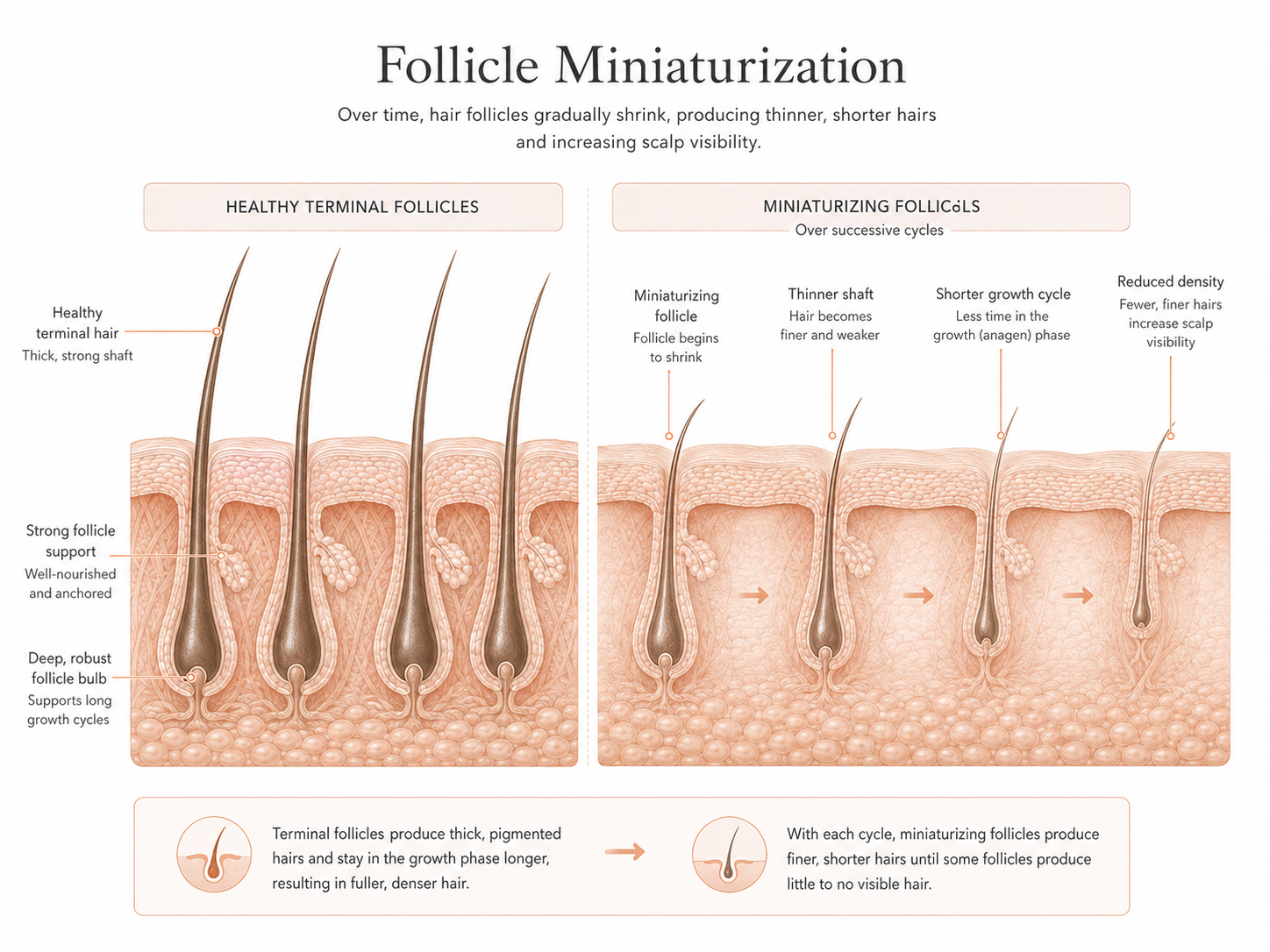
A healthy terminal follicle produces a thicker, pigmented hair. In pattern hair loss, susceptible follicles can gradually become smaller — a process called follicular miniaturization — and produce finer, shorter hairs over successive growth cycles.
This is different from simply "losing hair." The follicle is still there; it is making progressively less of a hair. Over time, shaft diameter decreases, growth cycles may shorten, density appears reduced and scalp visibility increases.
Why this matters: follicles that are miniaturizing but still viable generally offer more treatment opportunity than areas where follicles have been lost for years. Recognizing miniaturization early changes the plan.
Shedding and thinning are not the same thing
Two very different processes get described with the same word:
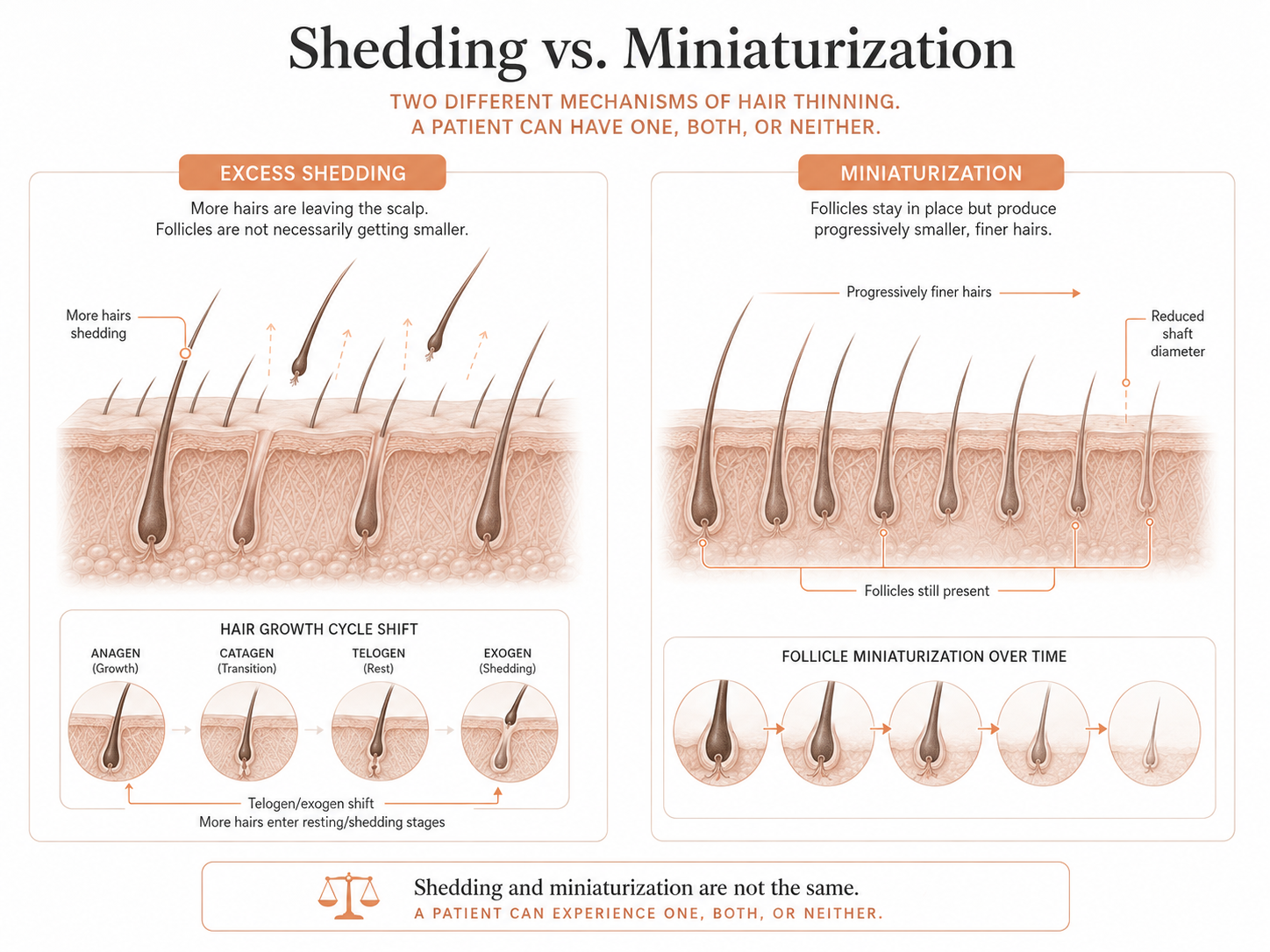
Shedding means more hairs are leaving the scalp than usual — follicles exiting the growth phase early and in numbers.
Miniaturization means individual follicles are progressively producing finer hairs, even when the number of hairs stays roughly the same.
A patient can have shedding without significant miniaturization, miniaturization without dramatic shedding, or both at the same time. The distinction changes treatment planning — a cycle-shift shedding problem and a progressive miniaturization problem are managed differently, and guessing between them is how patients end up on the wrong treatment.
Treatment paths
How we approach it
PRP Hair Restoration
Platelet-rich plasma delivers concentrated growth-factor signals into the scalp to support follicles that are still viable. Intended for patients whose thinning reflects miniaturization or reduced follicle activity — where the follicle exists but is underperforming.
PRF Hair Restoration
Platelet-rich fibrin is prepared more gently and releases its growth factors over a longer window through a natural fibrin scaffold. Intended for the same problem class as PRP; which preparation fits your scalp is a clinical decision, not a preference contest.
Prescription Hair Loss Medications
Topical or oral prescription treatment may be appropriate when the hair-loss pattern suggests a medical therapy can help preserve follicles, reduce progressive miniaturization, or support regrowth. The medication choice depends on the type of hair loss, hormones, health history, other medications, and individual risk factors.
Hormonal Evaluation & Optimization
When thinning reflects a hormonal driver — androgen sensitivity, menopause-related change, low testosterone or other hormonal imbalance — addressing that driver matters as much as any scalp treatment. This pathway exists for patients whose evaluation points in that direction.
Micronutrient Testing
Nutritional shortfalls — iron stores among them — are a common and correctable contributor to shedding and poor regrowth. Testing identifies whether deficiency is part of your picture so it can be addressed rather than worked around.
Scalp Microneedling (selected cases)
Controlled micro-injury to the scalp can support remodeling and is sometimes combined with regenerative approaches for selected patients. Not universal — suitability depends on your pattern, scalp condition and treatment goals.
The Better Off Way
Treat the reason your hair is thinning
Our approach follows the same principle across every hair-loss patient: find the driver, treat it specifically, and maintain the gains.
IDENTIFY
Determine whether the dominant issue is shedding, miniaturization, hormonal or genetic pattern, nutrition, inflammation, or a mixture — before recommending anything.
SUPPORT & STIMULATE
Correct appropriate underlying contributors and select targeted medical or regenerative treatment matched to your pattern and follicle viability.
MAINTAIN
Monitor response, protect follicles and adjust treatment as the hair cycle changes — progressive conditions need ongoing management, not one procedure.
Realistic expectations
Hair restoration is gradual because follicles operate on biological growth cycles — visible change takes time, and results vary by cause and by how much follicular loss has already occurred.
Follicles that are still viable generally offer more opportunity than areas where follicles have been permanently lost, which is why earlier evaluation tends to produce better outcomes. Maintenance may be necessary for progressive conditions — pattern hair loss does not stop on its own.
No treatment should promise a completely restored original hairline or density. What we can offer is an honest assessment of where your follicles stand, a plan matched to the actual driver, and monitoring to see whether it is working.
Your plan, your combination
Tools We May Use in Your Plan
These are the approaches we currently offer that genuinely relate to hair restoration — each matched to the problem it is intended to address. What you actually receive depends on what your evaluation shows.
Microneedling
Stimulate collagen, smooth texture, and refresh your skin — for fine lines, acne scars, pores, and skin texture.
Medical Hair Restoration
Prescription formulas, topicals, and regenerative treatments to reduce shedding and restore stronger, fuller-looking hair.
PRF Hair Restoration
Use your body's own growth factors to slow and reverse hair loss — strengthen follicles and support new growth.
Hormone Optimization
Provider-guided hormone balancing to restore energy, mood, strength, and vitality — so you feel like you again.
Micronutrient Testing
Comprehensive micronutrient testing that shows what your cells are actually missing — the foundation of a smarter wellness plan.
Real Medicine. Real Results.
The first step is an honest evaluation
We'll identify what's actually driving your concern, then build a plan around it — the right treatments, in the right order, with follow-through.
Frequently asked questions

Real Medicine. Real Results.