Better Off Solutions
Melasma, Sun Spots & Hyperpigmentation
Brown patches, sun spots and uneven pigmentation can look similar but have different causes — and they do not always respond to the same treatment.
Prefer to ask first?Text us|Call 760-452-2722
Brown spots are not all the same
Brown patches, individual sun spots, and marks left behind by acne or irritation can look similar at a glance — but they form through different mechanisms and sit at different depths in the skin.
That matters, because treating the wrong type of pigmentation the wrong way doesn't just underperform — it can sometimes make discoloration worse.
The first step is always identifying what you're actually seeing. A diagnosis can't be made from a website, but understanding the main pigment patterns helps you ask better questions about your skin.
What drives it
Why melasma behaves differently
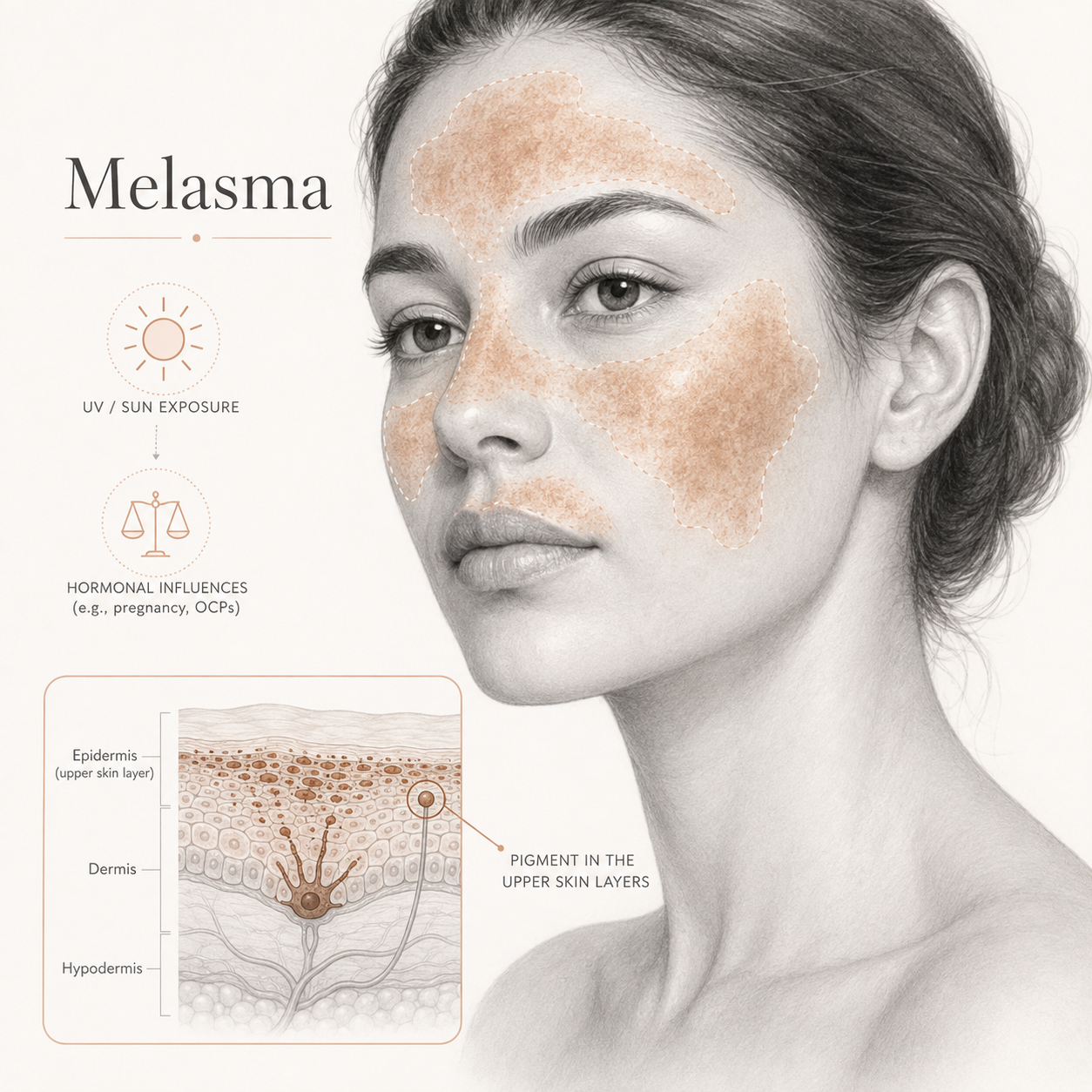
Melasma is not simply a surface stain. It reflects melanocytes — the cells that produce pigment — becoming overactive, and several forces can drive that activity:
- UV and visible light trigger pigment production directly.
- Heat can exacerbate melasma in many patients, even with diligent sunscreen habits.
- Hormonal influences — pregnancy, birth control, and other hormonal shifts — can contribute.
- Genetics set the baseline tendency.
- Inflammation from irritation or aggressive treatment can worsen pigment production.
Pigment may also sit at different depths — superficially in the epidermis, deeper in the dermis, or both — which changes how it behaves and what can reach it.
The honest framing: melasma is usually managed, not permanently cured. That is not discouraging news — it means the goal is meaningful, visible improvement through good management, with maintenance that keeps the result. Patients who control their triggers and stay consistent with care often see substantial change.
Not all pigmentation is the same
Brown spots and discoloration can have very different causes — and the wrong treatment can sometimes make pigmentation worse.
Melasma
Patchy, often symmetrical brown or gray-brown pigment, commonly across the cheeks, forehead, upper lip or jawline. Hormonal influences, UV and visible light, heat, and genetics can all contribute.
Sun Spots
More discrete, individual brown spots related primarily to cumulative sun exposure. They often respond differently than melasma — which is exactly why the distinction matters.
Post-Inflammatory Hyperpigmentation
Pigment left behind after inflammation or injury — acne, irritation, or procedures. These marks are not necessarily true scars, and they may need a different strategy than melasma.
Mixed Pigmentation
Many people have more than one type of discoloration at the same time. Clinical evaluation helps sort out what is driving what before treatment begins.
The Better Off Insight
Why aggressive treatment can backfire
Pigmentation-prone skin has a paradox built into it: the same skin that discolors easily can respond to excessive irritation, heat, or overly aggressive resurfacing by producing more pigment.
That is why the goal is never simply to use the strongest treatment available. The Better Off approach:
- Identify the pigment pattern before choosing anything
- Choose treatment intensity thoughtfully — matched to depth, skin type, and history
- Control inflammation rather than creating it
- Protect against triggers — sun, visible light, heat
- Reassess response before escalating
This does not mean lasers are off the table for melasma — it means selection and parameters matter enormously, and the wrong choice at the wrong intensity can make pigment worse.
Where the pigment sits matters
Two patches of pigmentation that look identical on the surface can behave completely differently, because depth drives response:
- Epidermal pigment sits more superficially. It often responds more readily to topicals, peels, and carefully selected light-based treatment.
- Dermal pigment sits deeper. It tends to be harder to clear and can respond more slowly — or unpredictably — to the same treatments.
- Mixed patterns are common: many patients have pigment at more than one depth at the same time.
This is why treatment choice and intensity should reflect the pigment pattern and your skin characteristics, not a fixed protocol. Treating deep pigment like surface pigment is one of the most common ways pigmentation care goes wrong.
Why melasma can come back
Recurrence is one of the most misunderstood parts of melasma — and it does not necessarily mean treatment failed. Melasma carries an ongoing biological tendency to produce excess pigment, and everyday triggers can reawaken it:
- UV and visible light exposure, including incidental daily exposure
- Heat — sun, saunas, hot yoga, even cooking over a hot stove for some patients
- Hormonal shifts
- Inflammation from irritation or harsh products
- Inconsistent sun protection
- Stopping maintenance once improvement is achieved
The practical takeaway: melasma care is a cycle of treatment, protection, and maintenance — not a one-time fix. When pigment returns, it usually means the triggers won the interval, and the plan adjusts rather than starting over.
Treatment paths
How we approach it
Pigment-Correcting Peels
Controlled exfoliation for selected superficial pigmentation — surface-level discoloration, uneven tone, and sluggish turnover, when matched to your skin type. Peel depth and strength are chosen for the pigment pattern, not the other way around.
Prescription & Non-Prescription Treatments
For patients whose primary issue is excess pigment production itself. Depending on the cause and severity, your plan may include medical-grade skincare, prescription or non-prescription topical therapy, and in selected cases oral support — the day-to-day layer of pigment control.
Laser & Light-Based Treatments
For selected sun damage and pigment patterns — discrete sun spots in particular can respond well. Suitability depends on diagnosis, skin type, pigment depth, and history; melasma requires more careful evaluation, because aggressive treatment can worsen it.
Combination Treatment Programs
For mixed pigmentation or stubborn patterns, the best result often comes from a sequenced combination — professional treatments, home care, trigger protection, and maintenance — rather than any single procedure.
The Better Off Way
Treat the pigment you actually have
Not a fixed protocol — a process. Every plan starts with identifying the pigment you actually have, treats the pattern rather than the label, protects against the triggers that drive it, and maintains the result over time.
Identify
Determine whether the problem looks primarily like melasma, sun damage, post-inflammatory pigment, or a mixture — and at what depth.
Treat
Choose the treatment appropriate to the pigment pattern, depth, and skin characteristics — intensity included.
Protect & Maintain
Reduce the triggers that drive pigment production, and continue appropriate home care and periodic treatment — because one procedure does not permanently remove the tendency.
Realistic expectations
Candor matters here. Pigmentation can often be improved substantially — but the goal depends on the cause:
- Melasma commonly requires ongoing management because the tendency to produce pigment remains. Good control can produce meaningful improvement; maintenance keeps it.
- Sun spots may behave differently — discrete spots often respond more definitively than melasma.
- Post-inflammatory pigmentation may fade over time on its own, but it can persist and sometimes needs treatment.
Results vary with pigment type and depth, skin type, trigger control, treatment selection, adherence to sun protection, and your inflammatory response. What should not vary: a plan that is honest about what it can deliver.
Your plan, your combination
Tools We May Use in Your Plan
The right combination depends on what is actually driving your concern — not every option fits every patient. After your evaluation, we build your plan from the treatments that genuinely apply.
Melasma & Sunspot Treatment
Fade melasma and sunspots with a combined approach — laser rejuvenation, oral medications, and medical topicals.
Medical Grade Peels
Medical-grade chemical peels for textural issues, fine lines, pigmentation, and melasma.
Laser Skin Rejuvenation
Laser resurfacing and rejuvenation for tone, texture, sun damage, and overall skin quality.
Carbon Laser Facial
The "black doll" laser facial — renew, regenerate, and refresh skin texture and tone with zero downtime.
Start from the concern, not the procedure
Explore by concern
Facial Aging & Volume Loss
Facial aging happens in layers — bone, ligaments, fat, muscle, and skin — and each layer needs a different answer. Better Off evaluates which layers are actually creating your concern, then builds a plan around them.
Acne Scars
Acne scars are not all the same. Their shape, depth, tethering and underlying tissue changes determine which treatments are most likely to help.
Protecting your results
Because pigment production is driven by triggers, protecting the result is half the treatment:
- Broad-spectrum sun protection, every day — the single most important maintenance step
- Visible-light protection where appropriate, especially for melasma-prone skin
- Hats and physical shade for extended outdoor time
- Avoiding unnecessary heat exposure when your melasma is heat-sensitive
- Minimizing irritation and inflammation — harsh products can undo progress
- An appropriate home pigment-control regimen matched to your skin
- Maintenance treatments as needed, rather than waiting for pigment to fully return
None of this is a product pitch — it is the practical routine that keeps the pigment you have cleared from coming back.
Real Medicine. Real Results.
The first step is an honest evaluation
We'll identify what's actually driving your concern, then build a plan around it — the right treatments, in the right order, with follow-through.
Frequently asked questions

Real Medicine. Real Results.